
SR & VPK Contract Requirements
Annual Provider Orientation — ELC of North Florida & ECS4Kids

Welcome to the ELC of North Florida & ECS4Kids Annual Provider Orientation on School Readiness (SR) and Voluntary Prekindergarten (VPK) Contract Requirements. Please select your provider type below — you will be guided through only the slides relevant to your program.
School Readiness (SR) Contract Requirements
Overview of provider obligations under the SR contract
This section covers the key requirements that all School Readiness providers must meet to remain in good standing with their SR contract. Topics include:
- Program Assessment (CLASS) — Annual classroom quality assessments, minimum thresholds, and Quality Improvement Plans
- Developmental Screening — Required screenings for SR children ages 6 weeks to 60 months
- Training & Technical Assistance — Resources available to SR providers and instructors
- Child Assessments (Optional) — Voluntary child assessment participation requirements
PROGRAM ASSESSMENT
School Readiness (SR) — CLASS & Quality Improvement
In this section you will learn about the annual Program Assessment requirements for SR providers, including the CLASS tool, Contract Minimum Threshold scores, exemptions, and Quality Improvement Plans.
Program Assessment: Rule 6M-4.740, F.A.C.
- The SR contract requires programs to participate in annual Program Assessments. The current approved tool is CLASS (Classroom Assessment Scoring System) by Teachstone, unless the provider is exempt.
- Exemption ends if/when SR enrollment increases to 20% of DCF capacity and/or the site receives qualifying DCF inspection violations.
- Once a provider becomes non-exempt, they cannot become exempt again unless a change of ownership occurs.
- Your SR contract will state the Contract Minimum Threshold composite CLASS score needed to remain eligible.
- If the threshold is not met, the provider may request one reassessment within 30 days, at their own cost.
Program Assessment: Quality Improvement Plan (QIP)
- SR Providers must maintain the Contract Minimum Threshold or implement a current Quality Improvement Plan (QIP).
- Your program will be notified if eligible/required to participate in a QIP.
- QIP Strategies will be determined in collaboration between the Provider and the Coalition.
- Technical Assistance will be available for Providers implementing a QIP.
Program Assessment: Helpful Resources
904-726-1500 ext. 2212 or ext. 2230
DEVELOPMENTAL SCREENING
School Readiness — Required Screening for Children Ages 6 Weeks to 60 Months
This section explains the annual developmental screening requirements for SR children, including timelines, parental consent, reporting obligations, and available Child Development Specialist support.
Developmental Screening Requirement: Rule 6M-4.720
- SR Parents/Providers must collaborate with the Coalition to complete initial screening and redetermination annually for each SR child, age 6 weeks to 60 months, within a specified time frame.
- Required time frames are listed in your SR contract and in your Provider Portal.
- Screenings are conducted with parental consent. Parents may decline screenings or defer them to the SR Provider to complete.
- We recommend providers check their Provider Portal weekly and complete screenings by the due date.
- Screenings not completed by the required due date will result in a non-compliance letter requiring completion of all due screenings and an action plan.
Developmental Screening: Reporting & Communication
- Providers must provide in writing the screening results with concerns for each child to the child's guardian.
- Staff are available to explain the screening process and results as requested.
- Please note: All comments a provider leaves on a screening will be visible to the parent/guardian. Ensure you have clearly communicated concerns with the guardian prior to completing their child's screening.
- Child Development Specialists are available to assist providers with developmental concerns, classroom management, and social emotional health of children.
Developmental Screening: Helpful Resources
904-726-1500 ext. 2281
TRAINING AND TECHNICAL ASSISTANCE
School Readiness — Provider Support Resources
ECS4Kids offers a range of training and technical assistance resources for School Readiness providers and instructors. This section outlines how to access trainings, coaching, and TA visits.
Training and Technical Assistance
Training and Technical Assistance is available to School Readiness providers and instructors!
🏫Find current ECS4Kids Trainings — ecs4kids.org/providers/regional-training-institute/ 🎦Coaching Videos — ecs4kids.org/providers/videos/ 📋Request TA: Technical Assistance Visits, Outreach & Resources904-726-1500 ext. 2230
CHILD ASSESSMENTS
(Participation Optional) — School Readiness
Eligible SR providers may choose to participate in optional child assessments. This section covers the requirements for providers who elect to participate, including timelines, approved tools, and staff certification requirements.
Child Assessment (Optional): Rule 6M-4.500
- Eligible SR Providers may choose to conduct optional Child Assessments.
- The Department of Education approves the tool(s) Providers may use to conduct these optional Child Assessments.
- Participating Providers must submit Child Assessments 3 times a year at designated checkpoints. Failure to submit by checkpoint dates listed in Rule 6M-4.500 will disqualify the provider from further participation that program year.
- Current training certification will be required of a percentage of Program Site Staff/Instructors and will be verified by a monthly staff roster.
904-726-1500 ext. 2230
Voluntary Prekindergarten (VPK) Contract Requirements
Overview of provider obligations under the VPK contract
This section covers the key requirements for VPK providers, including:
- VPK Program Assessment (CLASS) — Annual assessments with no exemptions for VPK classrooms
- Minimum Threshold Requirements — School-year and summer programs assessed separately
- Training & Technical Assistance — Resources specific to VPK providers and instructors
VPK PROGRAM ASSESSMENT
Voluntary Prekindergarten — CLASS Assessment Requirements
Unlike SR, all VPK classrooms must be assessed — there are no exemptions. This section covers VPK-specific CLASS assessment rules, threshold requirements, and scheduling guidelines.
VPK Program Assessment: Rule 6M-8.621
- The VPK contract requires programs to participate in annual Program Assessments using CLASS (Classroom Assessment Scoring System) by Teachstone.
- Your VPK contract will state the Contract Minimum Threshold. If not met, the provider may request one reassessment within 30 days, at their own cost.
- All VPK classrooms must be assessed — there are NO exemptions. If VPK classrooms open after a program receives its composite score, those new classrooms will also be assessed and a new composite score generated.
VPK Program Assessment: Scheduling & Thresholds
- VPK Providers must maintain the Contract Minimum Threshold for Program Assessments.
- VPK school-year programs and VPK summer programs are assessed separately and each receives its own composite scores.
- Assessments are conducted no earlier than 15 instructional days after start (school-year VPK) or 5 instructional days after start (summer VPK).
- A coalition-approved lead VPK instructor, aide, substitute, or VPK director will be assessed.
- Program Assessments must occur with at least 25% of enrolled VPK children present. Assessors will ask the provider to verify prior to starting.
VPK Program Assessment: Helpful Resources
904-726-1500 ext. 2212 or ext. 2230
VPK TRAINING AND TECHNICAL ASSISTANCE
Voluntary Prekindergarten — Provider Support Resources
ECS4Kids offers training and technical assistance to VPK providers and instructors. The following slide details available coaching, training events, and how to request a TA visit.
VPK Training and Technical Assistance
Training and Technical Assistance is available to VPK providers and instructors!
🏫Find current ECS4Kids Trainings — ecs4kids.org/providers/regional-training-institute/ 🎦Coaching Videos — ecs4kids.org/providers/videos/ 📋Request TA: Technical Assistance Visits, Outreach & Resources904-726-1500 ext. 2230
SCHOOL READINESS ELIGIBILITY
Child Eligibility, Enrollment, Copayments & Family Services
This section covers how families qualify for SR services, the enrollment process, parental choice and access requirements, copayment collection, and how to contact Family Services.
School Readiness Child Eligibility: Rule 6M-4.208
- Determines eligibility for families enrolling children into the School Readiness Program
- Manages: ELC of NF/ECS4Kids Waitlist and funding notices, initial enrollments & redeterminations, provider transfers & enrollment terminations, and assists families throughout the enrollment process.
- Household income & family size
- Work and/or education participation, or documented disability
- Families experiencing homelessness, domestic violence, or child welfare involvement with a referral from an authorized referring agency
Parental Choice
- Families may choose any School Readiness provider contracted with ELC of North Florida that meets their needs.
- Contracted providers include: center-based child care programs, family child care homes, public and nonpublic schools, and faith-based providers.
- The ELCNF and ECS4Kids provide families with information about available child care options but do not recommend or endorse specific providers.
- Families are encouraged to visit programs, ask questions, and review quality indicators to make informed choices about their child's early learning experience.
Parental Access
- School Readiness providers must comply with parental access requirements by allowing parents or guardians: unlimited access to their child, the child's classroom or care setting, and staff responsible for the child's care.
- Access applies during normal hours of operation and whenever the child is present in care.
- When a determination is made that a SR provider did not allow unlimited access as required, ECS4Kids will address the matter per the SR Contract, including corrective action when necessary.
School Readiness Enrollment Process & Provider Transfers
- After eligibility is approved, staff enroll the child in the family's selected child care program.
- The child will appear with status "Pending Family Acceptance" until the parent/guardian signs the payment certificate. Once signed, status changes to "Enrolled."
- Providers should confirm the child shows as "Enrolled" in both "Manage SR Enrollments" AND "Manage SR Attendance" before allowing the child to attend care.
- At-Risk Children on a referral will appear on the attendance roster whether the payment certificate is signed or not.
- Provider Transfers: A parent cannot transfer any child until the copayment obligation is satisfied per Rule 6M-4.400(5). All transfers must be approved by ECS4Kids prior to enrolling with another provider.
- Satisfaction of copayment obligation requires: Immediate payment of outstanding balance, or a repayment plan for the outstanding obligation.
- At-Risk Children on a referral cannot be denied a provider transfer; however, providers should document repayment attempts and submit to ECS4Kids if there is an outstanding balance.
School Readiness Copayment Collection
- The copayment amount for which a family is responsible will be subtracted from the provider's reimbursement prior to payment.
- Providers must collect copayments from families. Failure to collect copayments is a contract violation.
- Providers cannot waive, reduce, or negotiate copayment amounts — the amount set by the Coalition is the required amount.
- Copayment amounts are listed on the family's payment certificate. Providers should review the certificate at enrollment and at each redetermination.
Rilya Wilson Act — s. 39.604, F.S.
- The Rilya Wilson Act mandates that at-risk children in state custody aged birth to school entry attend a licensed child care or SR program five days a week.
- Providers must notify: the child's parent or guardian, the child's DCF case manager or referring agency representative (if applicable), and ECS4Kids / ELC of North Florida.
- Failure to report as required by the Rilya Wilson Act is a contract violation.
- Providers should document all notification attempts and keep records in the child's file.
- Children with a RWA referral are identified by a red check mark in the RWA column next to the child's name on the attendance roster.
SR Eligibility Resources
904-726-1500 ext. 7055
VPK CHILD ELIGIBILITY & ENROLLMENT
Family Services Department — VPK Eligibility, Parental Rights & Enrollment Process
This section covers VPK child eligibility criteria, the Certificate of Eligibility (COE) enrollment process, parental choice and access rights, prohibited fees, the Rilya Wilson Act obligations for VPK providers, and how to contact the Family Services Department.
VPK Child Eligibility: Rule 6M-8.201
Voluntary Pre-Kindergarten Child Eligibility Requirements
- Determines eligibility for families enrolling their children into the VPK Program.
- Manages: VPK child application submissions, initial enrollments, reenrollments, classroom transfers, and enrollment terminations.
- Assists families throughout the entire enrollment lifecycle.
- A child who resides in Florida.
- Child must be 4 years old by September 1 of the program year.
- Children who turn 4 between February 2 and September 1 may attend either the current or next VPK year, if they have not started Kindergarten.
VPK Parental Choice
- Families may choose any VPK provider that is contracted with the ELC of North Florida that meets their needs.
- Contracted providers include: center-based child care programs, family child care homes, public and nonpublic schools, and faith-based providers.
- The ELCNF and ECS4Kids provide families with information about available options but do not recommend or endorse specific providers.
- Families are encouraged to visit programs, ask questions, and review quality indicators to make informed choices.
VPK Parental Access
- VPK providers must comply with parental access requirements by allowing parents or guardians: unlimited access to their child, the child's classroom or care setting, and staff responsible for the child's care.
- Access applies during normal hours of operation and whenever the child is present in care.
- When a determination is made that a VPK provider did not allow unlimited access as required, ECS4Kids will address the matter in accordance with the Voluntary Pre-Kindergarten Contract, including corrective action when necessary.
VPK Eligibility Enrollment Process
Certificate of Eligibility (COE) and Provider Portal Enrollment
VPK Enrollment — Fees Prohibited
Reference: s. 1002.71(8)(a) & (b), F.S.
- Providers must not require payment of a fee or charge for services provided during the provider's VPK calendar instructional hours.
- Providers will not require the payment of any fees, or charge for supplemental services as a condition of admission into their VPK program.
Rilya Wilson Act (RWA): s. 39.604, F.S.
- Mandatory Attendance: Children in foster care (birth to school entry) must be enrolled and attend childcare five days a week.
- Prompt Reporting: Caregivers must notify the child care provider of any absence by the end of the day.
- Unexcused Absence Reporting: Providers must notify DCF and ECS4Kids if an at-risk child has an unexcused absence or seven consecutive days of excused absences.
- Restrictions on Removal: Children cannot be withdrawn from a program without prior written approval.
Family Services Department — Contact Us!
Our Family Services (FS) Department has offices in all six of our counties of service open Monday-Friday 8:00am to 5:00pm. Visit ecs4kids.org/locations/ to find the nearest office.
ATTENDANCE & REIMBURSEMENT
SR & VPK — Documentation, Sign-In/Sign-Out, Absences & Payment
This section covers attendance documentation requirements for both SR and VPK programs, monthly absence limits, notification requirements, reimbursement procedures, and best practices for keeping compliant records.
Attendance Documentation & Sign-In/Sign-Out Process
Rule 6M-4.500(1)(c), F.A.C. | s. 1002.84(10), F.S.
- Attendance Documentation. PROVIDER agrees to document daily attendance and submit monthly attendance reports for payment on or before the 3rd business day of each month. Records submitted late will be processed and paid in the next open payment cycle.
- Sign-In/Sign-Out Process. PROVIDER agrees to maintain daily attendance documentation, including a documented "sign-in/sign-out" process in accordance with Rule 6M-4.500(1)(c), F.A.C., and retain attendance documentation in accordance with s. 1002.84(10), F.S.
Sign-In / Sign-Out Sheet Requirements
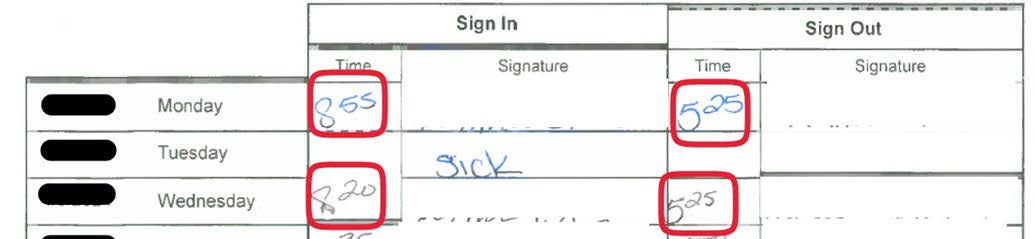
Sign-In / Sign-Out Sheet: Time Requirements
- Parents & Authorized Persons must sign in/out children as close to the minute as possible. Exact times — not rounded — are required.
- Technical Assistance will be given to a provider if sign-in/sign-out times show consistent 5-minute increments throughout the form.
Sign-In / Sign-Out Sheet: Signature Requirements
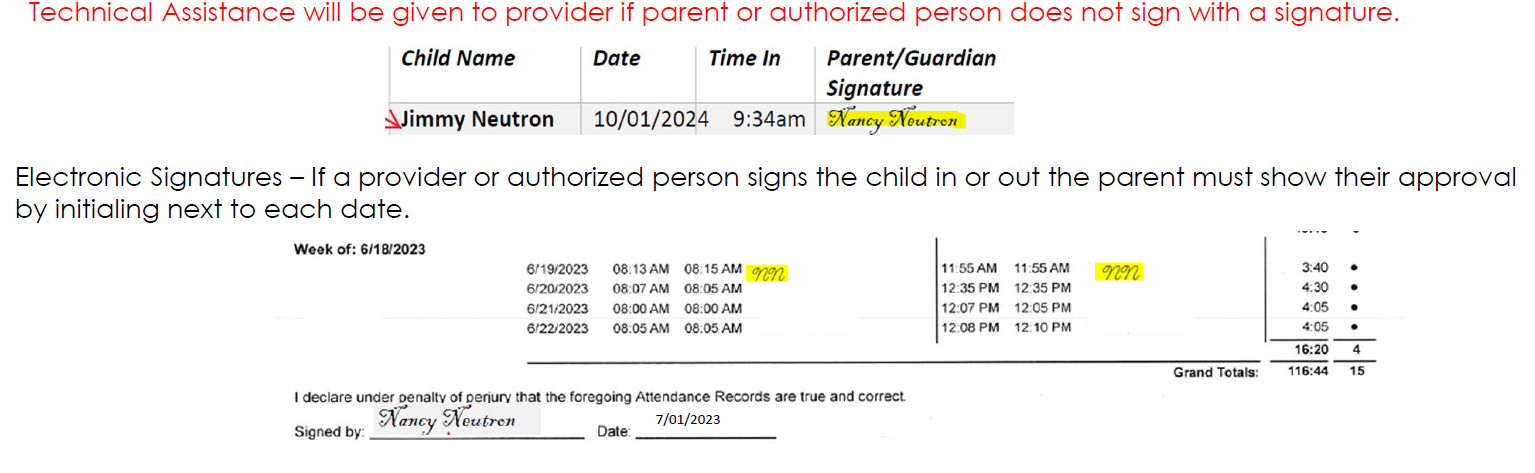
- Acceptable signature formats: First name, last initial (Nancy N.) / First initial, last name (N. Neutron) / Full signature (Nancy Neutron).
- Technical Assistance will be given to a provider if a parent or authorized person does not sign with a proper signature.
- Electronic Signatures: If a provider or authorized person signs the child in or out, the parent must show their approval by initialing next to each date.
Absences: Monthly Absence Limits
- Up to three (3) absences per child per calendar month may be reimbursed, without additional documentation.
- Any absences beyond three (3) are considered extraordinary circumstances and require additional documentation.
- 🩹 Hospitalization of the child or parent
- 🥵 Illness requiring home stay
- Death in the immediate family
- ⚖️ Court-ordered visitation
- 📸 Unforeseen military deployment or duty
- 🩺 Doctor or health-related appointments
Absences: Provider Notification Requirements
Written notification must be submitted to ECS4Kids when:
- 5 consecutive days of absence during scheduled attendance
- 10 unexplained absences in one calendar month
📌 One (1) unexcused absence
📌 Seven (7) consecutive excused absences
Notification must occur by close of business the same day. Providers must maintain documentation of all notifications.
Absences: Provider Best Practices
- Track absences daily — do not wait until the end of the month.
- Communicate with parents early when attendance patterns raise concern.
- Collect documentation promptly for extraordinary circumstances.
- Submit required notifications to ECS4Kids on time — same business day for at-risk children.
- Never alter, pre-fill, or backdate attendance sheets.
- Maintain documentation of all absences in each child's file.
Reimbursement
- Reimbursement Rates Established. PROVIDER agrees to accept the approved provider reimbursement rate identified in Exhibit 5 of this Contract. PROVIDER is paid based on budget availability, at the approved provider reimbursement rate less any parent co-payments.
- Every provider is reimbursed for the daily rate, whether it is full-time or part-time care.
Reimbursement: Summary Review & Portal
- Reimbursement Summary Review. PROVIDER agrees to review the reimbursement summary provided with the monthly statement and report any discrepancy, overpayment, or underpayment to COALITION in accordance with Rule 6M-4.500, F.A.C.
In the Portal go to: Attendance → Reimbursement Details
MONITORING
SR & VPK — Desk Reviews, On-Site Visits & Compliance
This section covers the monitoring obligations of ECS4Kids under the SR and VPK contracts, including Tier 1 Desk Reviews and Tier 2 On-Site Monitoring, what to expect during each, and what happens when findings are identified.
Monitoring Overview & Tiers
s. 1002.85(2)(g), F.S. | Form DEL-SR 20M | Rule 6M-4.630, F.A.C.
COALITION will monitor PROVIDER for compliance with this Contract in accordance with s. 1002.85(2)(g), F.S. using Form DEL-SR 20M, incorporated by Rule 6M-4.630, F.A.C.
CONTRACT REMINDERS
SR & VPK — Eligibility, Assessments, Holiday Schedule & Execution
This section contains important reminders from your SR and VPK contracts covering program assessment eligibility, child assessments, holiday schedule selection, and proper contract execution.
Program Eligibility, Child Assessment & Holiday Schedule
- Eligibility — s. 1002.82(2)(n), F.S. PROVIDER must have a program assessment score that meets the contract minimum threshold or be implementing a current Quality Improvement Plan in accordance with Rule 6M-4.740.
- ★ It is recommended that you do NOT waive your program's exemption.
- Child Assessment. If applicable, PROVIDER agrees to conduct child assessments using a reliable assessor at least three (3) times per year per Rule 6M-4.500, F.A.C. (SR ONLY).
- ★ To participate, providers must use TS Gold and be approved by the Education Department.
- Holiday Schedule. PROVIDER agrees to follow the COALITION-approved holiday schedule (up to 13 days/year per Exhibit 6). PROVIDER must use at least one day for staff training if 13 holidays are selected.
- ★ A 13th day may be selected for a staff training/development day only — documentation of training will be required.
SR Provider Profiles: Annual Update & Required Documents
In order to contract for SR and/or VPK, legally operating providers are required to maintain an updated and approved profile in the single statewide information system maintained by the Division of Early Learning (DEL). Annual updates occur between January 1 and May 31 of each calendar year.
VOLUNTARY PREKINDERGARTEN
Provider Profile Orientation — Annual Profile Updates & Required Documentation
This section covers the VPK-specific Provider Profile requirements including how to update your profile in the Early Learning Provider Portal, required supporting documentation, insurance requirements, and important compliance reminders specific to the Voluntary Prekindergarten program.
Provider Profile Update: 6m-9.300(8)(a)
Annual updates required to maintain SR and/or VPK contract eligibility
- In order to contract for School Readiness and/or VPK, legally operating providers are required to maintain an updated and approved profile in the single statewide information system maintained by the DEL.
- Annual Updates for the upcoming program year occur between January 1 and May 31 of each calendar year. Additional updates can be made throughout the year, as needed.
Required Documentation: Certificate of Accreditation & Gold Seal
A licensed child care facility, licensed family day care home, licensed large family child care home, or a nonpublic/faith-based provider exempt from licensure participating in Florida's VPK Education Program must upload a Certificate of Accreditation from a state-recognized accrediting association, such as:
- Higher reimbursement for School Readiness providers.
- Eligibility to participate in VPK — Proof of the Gold Seal Quality Care Accreditation may be required.
Required Documentation: License, E-Verify, W-9, Sunbiz & Curriculum
Required Documentation: Insurance Requirements
- Minimum $100,000 coverage per occurrence and minimum $300,000 general aggregate coverage.
- List the following as a certificate holder and additional insured:
8649 Baypine Road, Bldg. 7, Ste. 300
Jacksonville, FL 32256
- Required if provider has 4 or more employees.
- Workers Comp Waiver — Required if fewer than 4 employees.
- Required if your program transports children.
ATTENDANCE AND REIMBURSEMENT
Voluntary Prekindergarten — Attendance Submission, Absences, Advance Payments & Reimbursement
This section covers VPK-specific attendance documentation submission requirements, parent attendance certification, the 80:20 absence policy, advance payment options, and how reimbursement works for VPK programs.
- Attendance Documentation Submission. PROVIDER agrees to submit monthly attendance certification on or before the 3rd business day of each month. Records submitted late will be processed in the next payment cycle.
- Parent Attendance Certification. PROVIDER agrees to require that the parent of each child verify, each month, the child's prior month attendance. PROVIDER agrees to maintain signed Child Attendance and Parental Choice Certificates (Forms OEL-VPK 03L or OEL-VPK 03S).
VPK Absences: The 80:20 Attendance Policy
- Each child will be paid for up to 20% of absences based on the time the child attended.
- The revised policy does not differentiate between excused and unexcused absences — documentation (doctor's notes, etc.) is not needed.
- The 80:20 attendance calculations are applied monthly and at the end of each VPK class.
- School-year VPK program: Cannot exceed 540 instructional hours
- Summer VPK program: Cannot exceed 300 instructional hours
VPK Advance Payments
- PROVIDER may elect to receive monthly advance payments based on the number of children enrolled.
- ★ A provider has the choice to opt in or out of receiving Advance payments.
- Advance payments will be paid at 95% of the hourly rate of the anticipated monthly payment — not 100%.
- If your program is not approved by the advance payment deadline, you will NOT receive an advance payment for that month.
- The advance payment is reconciled monthly and any reconciliation is added or subtracted from your next advance payment.
VPK Reimbursement
- Reimbursement Summary Review. PROVIDER agrees to report to COALITION any discrepancy, overpayment, or underpayment within sixty (60) calendar days of transmission of the reimbursement summary.
In the Portal go to: Attendance → Reimbursement Details
CONTRACT REMINDERS
Voluntary Prekindergarten — VPK Application, Instructor Requirements & Notifications
This section covers VPK-specific contract reminders including minimum program hours, class size limits, VPK Director Credential requirements, instructor qualifications, notification obligations, and VPK monitoring expectations.
VPK Application: Hours, Class Size & Director Credential
- A school-year VPK program must be at least 540 instructional hours.
- A summer VPK program must be at least 300 instructional hours.
- Provider must have a minimum of four (4) children to begin their VPK Class.
- Provider cannot exceed more than 20 children — may not exceed licensed capacity.
All VPK Directors are required to hold a VPK Director Credential or a valid certificate in educational leadership issued by FDOE. Requires completion of:
- Implementing the Florida Standards in Preschool Classrooms — online VFSP (0.5 CEUs)
- Emergent Literacy for VPK Instructors — online VPK, VPKR or VPK21 (0.5 CEUs)
- Mathematical Thinking for Early Learners — online MATH or MATH25 (0.5 CEUs)
- Language and Vocabulary in the VPK Classroom — online LVPK or LVPK21 (0.5 CEUs)
- VPK Director Credential Course — online DVPK (0.5 CEUs)
VPK Application: VPK Instructor Requirements
For each VPK class, at least one VPK instructor must meet one of the following qualifications:
- A bachelor's or higher degree in early childhood education, Prekindergarten or primary education, preschool education, or family and consumer science.
- A bachelor's or higher degree in elementary education with certification to teach children ages birth through 6th grade.
- An associate or higher degree in child development.
- An associate or higher degree in an unrelated field, at least six credit hours in early childhood education, and at least 480 hours of experience with children birth through 8 years.
- An educational credential approved by the Department of Education as equivalent or greater.
VPK Application Continued: Additional Staffing & Background Screening
- For each VPK class of 12 or more children, at least one additional instructor who has a current Level 2 background screening is required.
- Employ instructors of good moral character.
- Complete background screening (Level 2 per s. 435.04, F.S.) for all instructors.
VPK Notifications: Information Change Notification
VPK Monitoring & Execution of Contract
- Parental Choice Certificates for randomly selected children
- Selected children's sign in/out sheets
- Your VPK attendance policy
- Teachers match ECS4Kids approved applications
- Class(es) within proper VPK ratio
- Classroom meets VPK Standards
VPK FAST
Florida Assessment of Student Thinking — VPK Assessment Requirements
This section covers the required Florida Assessment of Student Thinking (FAST) assessments for VPK programs, including administration requirements, testing accommodations, parent reporting obligations, and test administrator training requirements.
🌐FLDOE Early Learning — fldoe.org/academics/standards/subject-areas/early-learning/VPK FAST: Assessment Requirements
PM1 | PM2 | PM3 — Three Assessment Periods Per Program Year
- VPK Programs must administer the assessment three times (PM1, PM2, PM3) by a qualified test administrator.
- The assessment shall be administered individually or in a small group with no more than five students.
- The assessment shall be administered on a touchscreen device. Student headphones shall be used for groups of two to five students.
- Testing accommodations shall be made in accordance with a student's current IEP or 504 Plan.
- VPK Programs must provide performance results to the student's parents within seven (7) calendar days via the Star Parent Report.
VPK FAST: Test Administrator Requirements
- You MUST have a trained and documented VPK FAST Test Administrator for your program.
- This training is a yearly requirement. Make sure your Test Administrators have completed the new program year VPK Test Administrator Course on Educator Academy prior to testing.
- Training is completed through the Educator Academy.
VPK Accountability Performance Metrics and Designation
Provider & Family Services Departments — Contact Us!
When prompted for your "Title", please type your job title such as Owner or Director.
Thank you for completing the ELC of North Florida & ECS4Kids Annual Provider Orientation. You are now ready to proceed to the Orientation Completion Form. Keep this contact information handy should you have any questions.
You have reviewed all required slides for your provider type. Click below to proceed to the Orientation Completion Form.